500,000 devices processed with zero guesswork on which one failed
Industry challenge
High-volume device processing operations work in batches. Devices arrive, are logged, and move through diagnostics, erasure, configuration and testing before being released. The bottleneck is rarely the workflow itself - it is the moment a quality control check fails and the technician has to work out which of the ten devices on the bench is the faulty one.
Standard USB hubs pass data through but reveal nothing about topology, so identification falls back to manual methods: turning devices over to read a serial number that a protective case may obscure, removing the case entirely, or tapping through setup screens. At scale, that time compounds into a direct throughput and margin problem, especially when used devices lose value with every week they sit unprocessed.
How we help
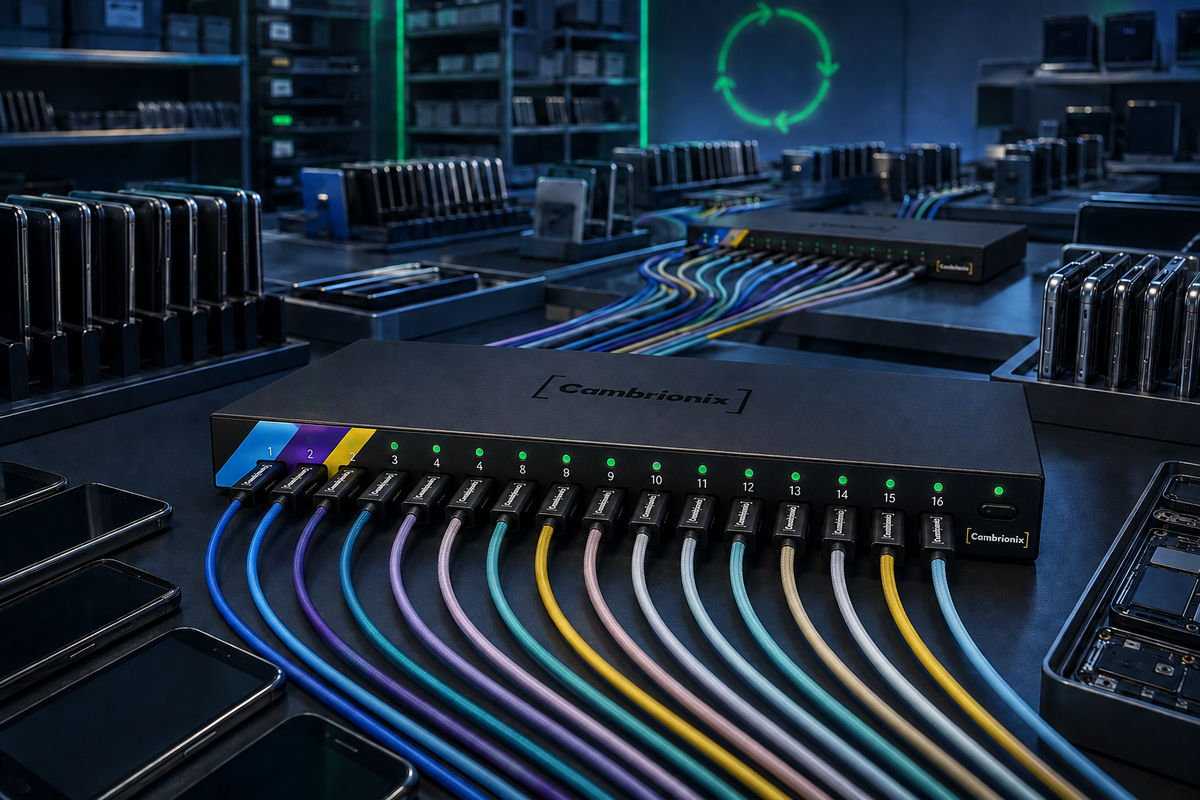
A large-scale device processing and integration provider running batches of ten devices per station adopted Cambrionix hubs specifically for the Hub API, which exposes both which hub and which port a device is connected to. Having evaluated Cambrionix against two competing vendors, the team identified this as the deciding capability: the alternatives could synchronise devices but could not tell an operator where a given device physically was.
The provider fed that data into an in-house API and built its own dashboard showing every device against its station, hub and port. Cables were physically labelled to match port numbers, so a fault reported on port one leads the technician straight to the device. Per-port control added a second gain: a fully provisioned device that is low on charge can have its port switched to charge-only for a boost, rather than trickle-charging while occupying a sync slot. The team now runs 32 hubs, expanding towards 40, and monitors hub health as well as device state.
Step-by-step solution
- Evaluate managed USB hubs against competing vendors on control and visibility, not port count - using loan units to test integration before committing
- Use the Hub API and command-line interface to read hub and port identity for every connected device
- Feed that data into an in-house API and dashboard, and label cabling so port numbers map to physical positions
- Script per-port power management so low-charge devices are boosted automatically without blocking a processing slot
- Monitor hub health alongside device state, so infrastructure faults are identified rather than being attributed to the devices.
Results
- Around 15 minutes saved per batch of ten devices by removing manual fault identification
- Approximately 500,000 devices processed in four years, including 200,000 in a single year
- 36,000 devices processed in a two-month project, attributed largely to the Cambrionix infrastructure
- Technicians are productive from day one; training on the process no longer requires learning manual identification methods.
Get in touch with us
Want results like these for your team? Talk to us about your use case.
Get in touch